
If you’ve been told you have a bulging disc or herniated disc, it can sound intimidating—especially if you’re also dealing with back pain, neck pain, sciatica, numbness, tingling, or weakness.
You may wonder:
- Is a herniated disc worse than a bulging disc?
- Can the disc heal?
- Do I need surgery?
- Is it safe to exercise?
- Can chiropractic care help?
The good news is that an abnormal disc finding does not automatically mean surgery or permanent pain. Many people with disc-related problems can be managed conservatively, depending on their symptoms, examination findings, and neurological function.
At Good Life Chiropractic in Sartell, MN, our goal is to determine what may actually be contributing to your symptoms and develop a plan designed to help you move, function, and feel better.
First, What Is a Spinal Disc?
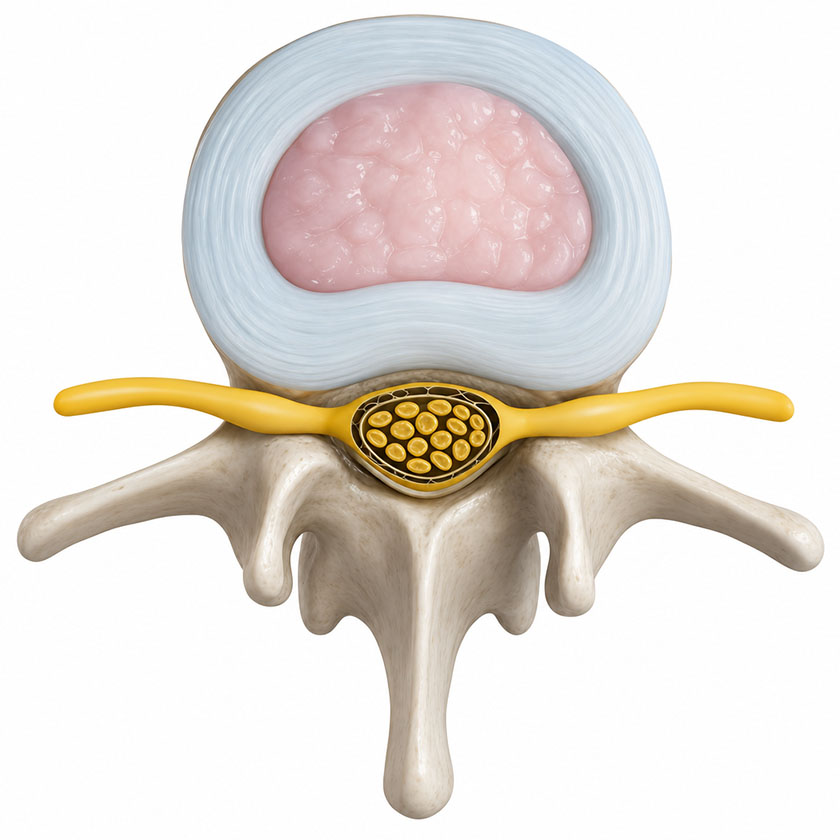
Between most of the vertebrae in your spine are intervertebral discs.
Think of a spinal disc as a strong, flexible cushion. Each disc contains:
The annulus fibrosus: the tougher outer portion of the disc.
The nucleus pulposus: the softer, gel-like material toward the center.
Your discs help distribute load through the spine while allowing you to bend, twist, walk, lift, exercise, and perform everyday activities.
Over time, discs naturally change. Injury, repetitive loading, genetics, aging, and other factors can also affect their structure.
That is where terms such as disc bulge, protrusion, extrusion, and herniation begin to appear.
What Is a Bulging Disc?
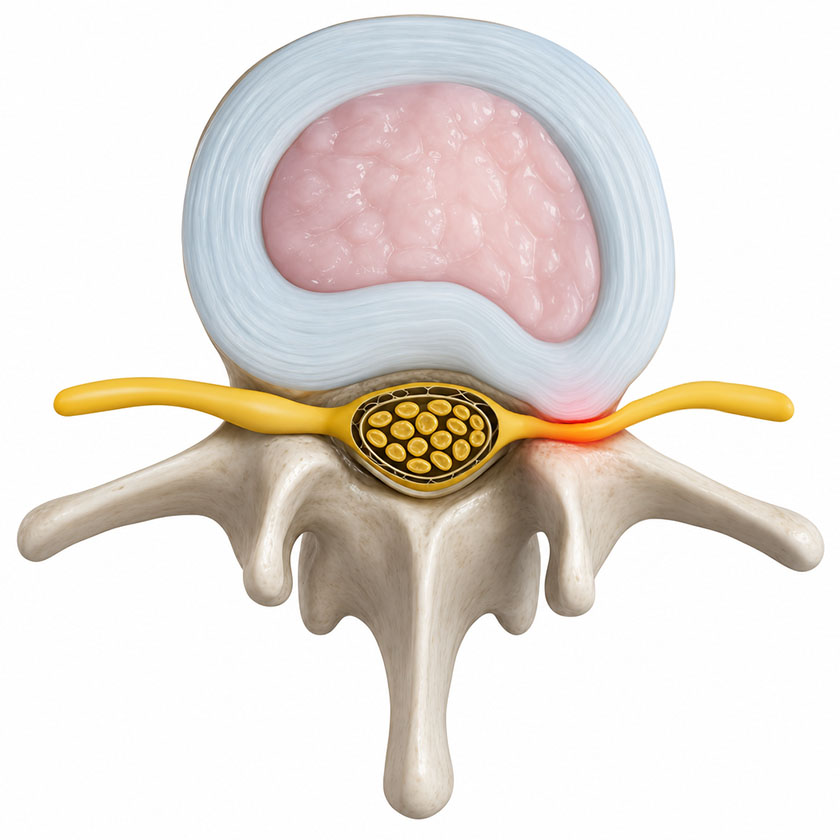
A disc bulge generally describes a broader extension of the disc beyond its normal boundary.
Rather than one small focal area pushing outward, a larger portion of the circumference of the disc extends beyond where it would normally sit.
A bulging disc doesn’t necessarily cause pain.
In fact, disc changes can sometimes appear on imaging in people who have few or no symptoms. This is one reason we don’t want to treat an MRI report alone—we want to understand whether the imaging findings actually correspond with your symptoms and examination.
When a bulging disc does contribute to symptoms, you may experience:
- Localized back or neck pain
- Stiffness
- Pain with sitting or bending
- Pain during certain movements
- Muscle tightness or guarding
- Radiating discomfort into an arm or leg
- Numbness or tingling if a nerve is irritated
What Is a Herniated Disc?
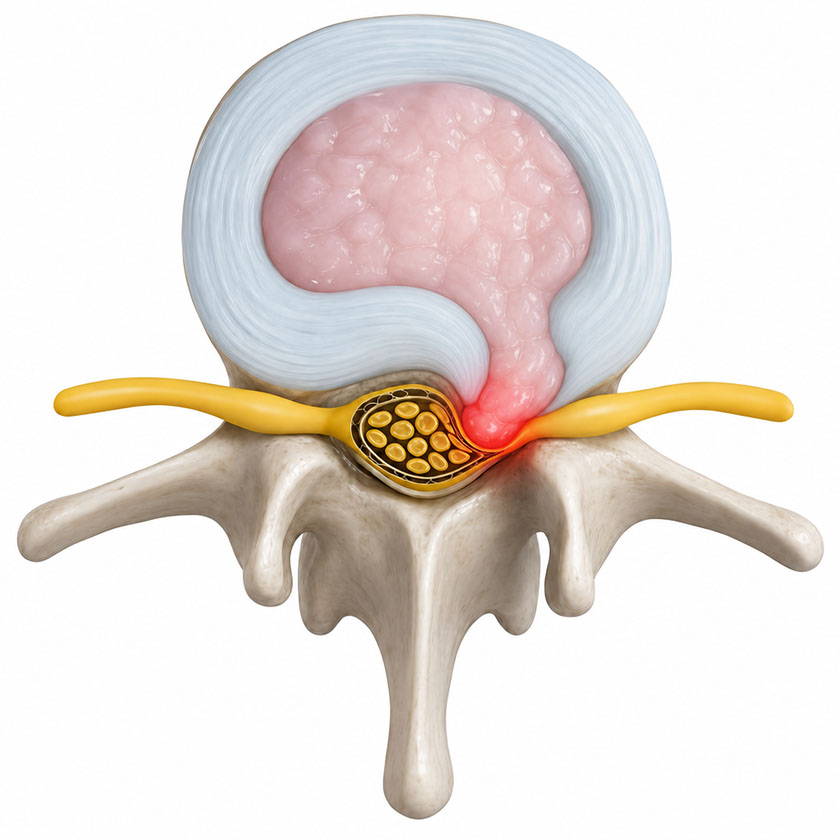
A herniated disc occurs when disc material becomes focally displaced beyond its normal boundary. Depending on its shape and extent, an MRI report may use terms such as protrusion or extrusion.
A herniation becomes particularly important when the displaced disc material irritates or compresses a nearby spinal nerve.
A lumbar disc herniation in the lower back can contribute to symptoms traveling into the buttock, hip, leg, or foot—often described as sciatica.
A cervical disc herniation in the neck may contribute to pain, numbness, tingling, or weakness traveling into the shoulder, arm, or hand.
Bulging Disc vs. Herniated Disc: What’s the Difference?
The easiest way to think about it is:
Bulging disc: A broader portion of the disc extends beyond its normal boundary.
Herniated disc: Disc material extends outward in a more focal area and may involve disruption of the outer fibers of the disc.
But here’s something important:
The MRI finding isn’t always what determines how much pain you experience.
A relatively small disc problem in the wrong location can irritate a nerve and create significant symptoms.
Another person may have a more obvious disc abnormality on an MRI but relatively little discomfort.
That is why your symptoms, neurological examination, movement, strength, sensation, reflexes, and functional limitations matter alongside any imaging findings.
What Does a Disc Problem Feel Like?
Disc-related symptoms can vary considerably from person to person.
Some people primarily experience back or neck pain.
Others experience more neurological symptoms.
Common complaints may include:
- Low-back pain
- Neck pain
- Pain into the buttock or hip
- Sciatica
- Pain traveling down the leg
- Pain traveling into the shoulder or arm
- Numbness or tingling
- Burning or electric sensations
- Muscle weakness
- Increased discomfort while sitting
- Pain with bending or lifting
- Difficulty getting comfortable at night
- Pain with coughing or sneezing
- Reduced ability to exercise, work, or perform normal activities
Those symptoms don’t automatically mean you have a herniated disc. Several other conditions can produce similar symptoms, which is why an appropriate evaluation matters.
Does a Herniated Disc Mean You Need Surgery?
Not necessarily.
Many people with lumbar disc herniations improve without surgery, and conservative treatment is commonly considered first when there are no signs requiring urgent surgical evaluation.
The correct approach depends heavily on the individual.
That is also why we don’t believe every patient with a disc problem should receive exactly the same treatment.
How We Evaluate Disc-Related Problems at Good Life Chiropractic
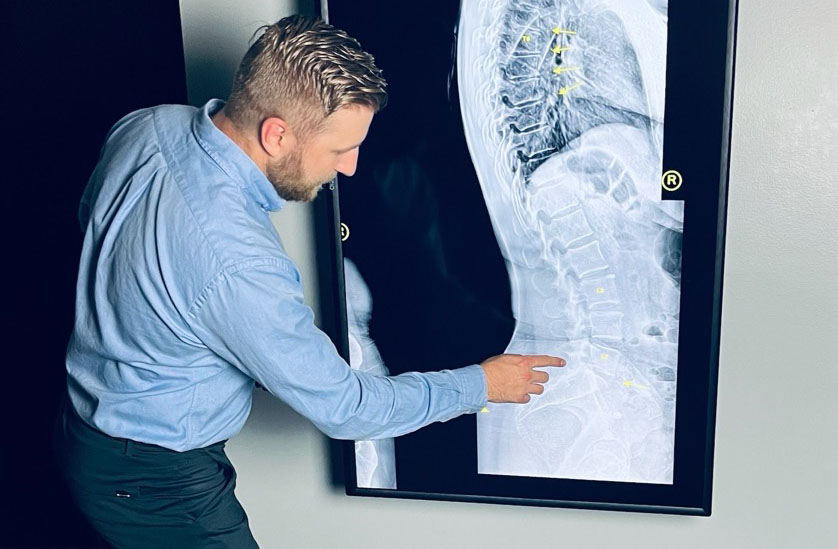
When someone comes to Good Life Chiropractic with suspected disc or nerve-related symptoms, we want to understand why the problem is happening and how it is affecting their function.
Our evaluation may include:
1. A Detailed History
We want to know:
- Where your symptoms started
- Where the pain travels
- What movements make it better or worse
- Whether you have numbness or tingling
- Whether you’ve noticed weakness
- Previous injuries
- Previous imaging or diagnoses
- What activities you’re currently unable to perform
2. Neurological and Orthopedic Examination
Disc problems can affect more than just pain.
When appropriate, we evaluate things such as strength, sensation, nerve-related symptoms, movement, orthopedic findings, and neurological function.
3. Movement Assessment
We also look at how your spine, hips, and surrounding areas move.
If your body is repeatedly loading one area poorly, simply getting temporary pain relief may not address the entire problem.
4. Imaging When Appropriate
Digital X-rays can help us evaluate the bony structure of the spine, alignment, degeneration, and other structural findings when imaging is clinically appropriate.
However, an X-ray does not directly show a bulging or herniated disc.
When detailed visualization of the disc, spinal canal, or nerve roots is necessary, MRI is typically much more useful. We may recommend additional imaging or referral when the examination indicates that it is needed.
How Can Good Life Chiropractic Help With a Bulging or Herniated Disc?
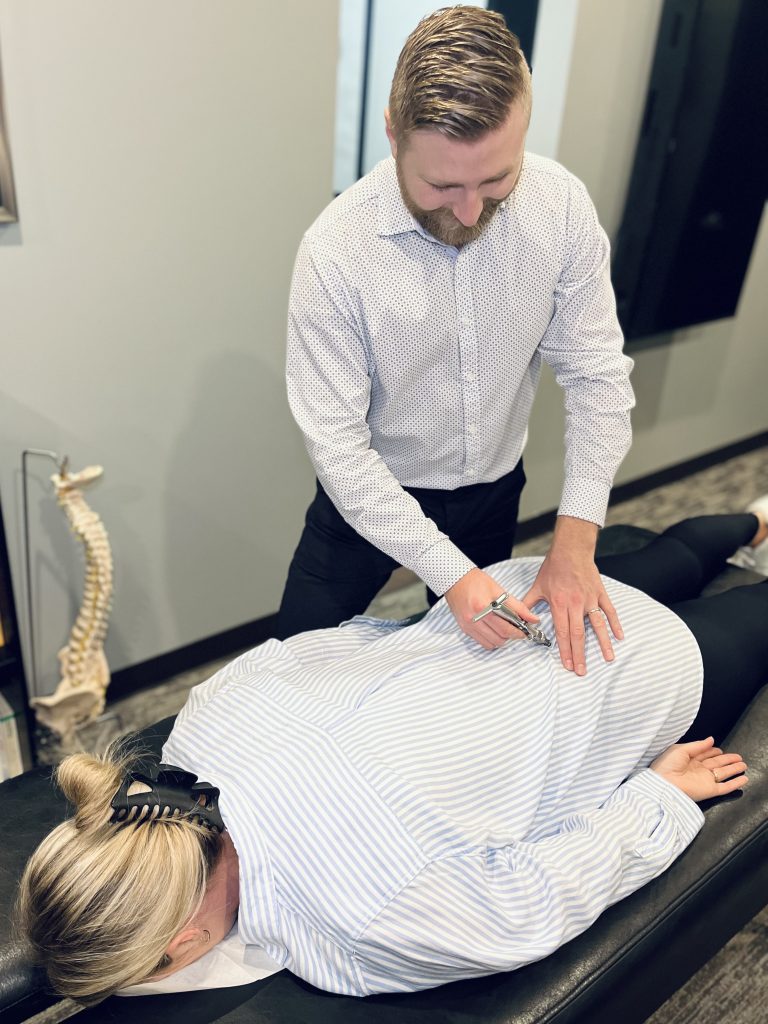
Our goal isn’t to simply “push a disc back into place.”
That oversimplifies what is happening.
Instead, treatment is designed around improving how your spine and body are functioning while reducing aggravating stress and helping you gradually return to normal activity.
Depending on what we find, your care may include several components.
Specific Chiropractic Adjustments
At Good Life Chiropractic, we use both Gonstead Technique and Torque Release Technique.
This gives us the ability to use specific hands-on adjusting or a gentler instrument-assisted approach depending on the individual and what we find during the examination.
With disc-related cases, the treatment approach should be modified based on symptoms, neurological findings, tolerance, and the location and severity of the problem.
The goal isn’t simply to create movement everywhere. It is to determine where treatment is appropriate and where additional caution or referral may be necessary.
Functional Movement and Rehabilitation
Feeling better is important.
But we also want you to function better.
Depending on your condition, rehabilitation may focus on improving:
- Core control
- Hip mobility
- Spinal stability
- Movement mechanics
- Lifting technique
- Strength
- Tolerance to sitting or standing
- Gradual return to exercise
We use movement assessment, corrective exercise, mobility work, stability training, and practical home care as part of our approach when appropriate.
Low-Level Laser Therapy
Low-level laser therapy may also be incorporated as a supportive therapy when pain, inflammation, or tissue irritation is limiting progress.
At Good Life, we use Erchonia® low-level laser therapy alongside other treatment when it fits the patient’s examination and care plan rather than treating it as a stand-alone solution.
Soft Tissue and Muscle Work
When your back or neck hurts, surrounding muscles often tighten and guard the painful area.
Soft tissue techniques, percussor work, vibration therapy, mobility work, and other supportive therapies may be used to address muscle tension and help restore more comfortable movement.
What Should You Avoid With a Suspected Disc Problem?
There isn’t one universal list of “bad exercises” for everyone with a disc injury.
In fact, avoiding movement indefinitely can be counterproductive.
Instead, we generally want to identify movements that repeatedly reproduce or worsen your symptoms, especially if pain begins traveling farther into an arm or leg or neurological symptoms increase.
Early on, some people may need to temporarily modify:
- Heavy lifting
- Repeated bending under load
- Aggressive twisting
- Prolonged sitting
- Exercises that increase radiating pain
- Activities that significantly increase numbness or tingling
The goal isn’t permanent restriction.
The goal is to calm the irritated area, restore capacity, and progressively return you to the activities that matter to you.
When Should a Disc Problem Be Evaluated Urgently?
Most episodes of back pain and many disc problems are not emergencies.
However, certain neurological symptoms require prompt medical evaluation.
Seek urgent medical attention if back pain is accompanied by symptoms such as:
- New loss of bowel or bladder control
- Numbness around the groin or saddle region
- Rapidly progressing leg or arm weakness
- Major loss of coordination
- Severe symptoms following significant trauma
- Other concerning systemic symptoms
Progressive neurological loss shouldn’t simply be treated as routine back pain.
Disc Pain Treatment in Sartell, MN
At Good Life Chiropractic, we don’t want to provide the exact same treatment to every person who walks through the door with back pain.
We combine specific chiropractic care with neurological and structural assessment, functional movement and rehab, low-level laser therapy, soft tissue work, home recommendations, and imaging when appropriate to develop a plan based on what we find.
Our goal is to help you understand what’s happening, decrease the limitations your problem is creating, improve the way your body moves and functions, and help you get back to enjoying life.
If you’ve been diagnosed with a bulging disc or herniated disc, or you’re experiencing back pain, neck pain, sciatica, numbness, or tingling and aren’t sure why, the first step is determining what is actually contributing to the problem.
Good Life Chiropractic
1733 Pine Cone Rd S #1200
Sartell, MN 56377
320-217-2542
Serving Sartell, St. Cloud, Sauk Rapids, Waite Park, St. Joseph, and surrounding Central Minnesota communities.
Ready to Find Out What’s Causing Your Pain?
Schedule a new patient evaluation at Good Life Chiropractic so we can assess your spine, nervous system, movement, and symptoms and determine whether our approach is appropriate for you.
Move better. Heal better. Get back to living your life.
Frequently Asked Questions
Is a herniated disc worse than a bulging disc?
Not necessarily. A herniation may represent a more focal displacement of disc material, but the severity of someone’s symptoms depends on factors such as location, inflammation, nerve involvement, and neurological findings. A larger-looking abnormality doesn’t always produce worse symptoms.
Can a bulging disc cause sciatica?
Yes. If a lumbar disc abnormality irritates a nerve root that contributes to the sciatic nerve, symptoms can travel from the lower back or buttock into the leg.
Can you have a herniated disc without back pain?
Yes. Some people experience predominantly leg or arm symptoms, and some disc abnormalities may be present without significant symptoms.
Can an X-ray show a herniated disc?
No. Standard X-rays primarily show bones. They can provide useful information about spinal structure and other bony findings, but MRI is typically better when direct visualization of discs and nerve structures is necessary.
Can chiropractic care help everyone with a herniated disc?
No. Disc problems vary widely. Chiropractic care may be one component of conservative management for an appropriately selected patient, but significant or progressive neurological deficits and other concerning findings may require medical imaging, specialist evaluation, or other treatment. The examination should determine the appropriate course rather than assuming every disc problem should be treated the same way.
